And should I leave behind
Lord Byron- Childe Harold’s Pilgrimage
The inviolate island of the sage and free
And seek me out a home
By a remoter sea
My first overseas trip after becoming a Japanese citizen was to India. I expected the trip to be a rollercoaster of emotions, but I was sick throughout the trip and the active viruses dampened, I thought at that time, any prospects of emotions to germinate.
I went back a few months later and was healthy throughout and that is when I realised that sickness did not dampen my emotions, there were never there!
Travel is more than getting on a plane, it is about landing in different countries, getting processed by immigration, asked questions that range from polite to rude and dismissive and after a while you detach yourself from the process.
The experience of travel starts from leaving the airports, the mind blocks out the administrative processes, the paperwork, the queuing up and anything else that stands in the way of getting out of airports .
When I took my first trip to India on a Japanese passport, I still retained my Indian one. I did not have the time to apply for the documents that are required for me to surrender my passport.
I traveled on a visa, I could not use my Indian passport to travel, navigating the sometimes complex processes required to apply for a visa. The irony was that applying a visa at a 3rd party site was much simpler and quicker than applying it at the government run site, though much more expensive.
There was nothing new about applying for visas I had done that for decades now, the realisation that travel to India would be change for me did not really make a difference. Then there was the frustration at the application process and any emotion that would have dared to erupt was suppressed.
I lived in eight different cities in the first decade of my working life before moving to Tokyo in 2007 and I have stayed put in this city ever since. There was little time to form attachments to the cities in my first decade and even after moving to Tokyo I changed houses and localities a few times.
Home is, I suppose, just a child’s idea. A house at night, and a lamp in the house. A Place to feel safe.
VS Naipaul
The only emotion I could remember was the one at leaving my hometown thirty years ago. There was a realisation that there was no coming back, all future visits would be as a visitor. The attachment to a place faded after that and did not reappear.
Growing up between cultures I was used to the yearning to belong and the constant rejection that came with it. The definition of home was altered it wasn’t a distant town or state where your forefathers came from, it was where you grew up, made friends and stayed for a while.
The realisation that you were different was constantly reinforced on the annual trips to the hometowns of my parents and there was an acceptance of not belonging.
There was the added complexity of a family that moved to a new region every generation. A new culture got added with each move but it also meant there was no single identity, you could toggle a few and flit in and out of each one with ease.
But there was also the lack of an anchor, a culture to hold me down, something to owe allegiance to and hold as one’s own. I have struggled to find a cultural doppelgänger, someone who could empathise in the lack of bearings but have failed.
I think it’s important for people not to feel rooted in one place. So wherever I am , I feel I’m on the run in some way. I’m devoted to my native language, but I cannot think it as natural, because, to an extent, one is never natural… one is never at home
Gayatri Spivak- Literary Critic
But I have avoided getting sequestered into the ethnic enclaves that Indians create when abroad. They try to recreate what they have lost, find comfort in a shared ethnicity and reclaim their being. But what do I reclaim, not having lost anything?
Home was hardly a place I could return to. Home was something in my head. It was something I had lost
VS Naipaul- A Bend in the River
I have considered Japan my home for many years now, it is difficult to identify when the the feeling of belonging finally entered but there was a stage when the annual trips to India ceased to be visits to home.
There are no cords tying me to a hometown, I don’t have a home in the town that I grew up, the city has moved on, the existence erased. The language still ties me to the place, meeting someone who speaks the language sets off a nostalgia but when the encounter ends, mostly fleeting and rarely extended, the nostalgia is gone.
The return to the present is more revealing than the encounter, the comfort is in the return to the present and not the wobbly memories of the past.
The Journey
My first trip back to India on a Japanese passport was not a pleasant one, the discomfort was physical and not emotional.
I was sick when I left Japan, my throat felt sore and I realised that I was coming down with a cold. I got sicker when I reached Mumbai, the head was heavy, my body hurt and each day was a struggle. I was there on work and had to take long cab rides to get to my meetings and the best time of the day was when I was back in my hotel room, sick and tired and collapsing on my bed.
There was no time to reflect on the new experience, no time to romanticise or feel emotional, physical discomfort can ward off any incoming emotions.
There was an ENT doctor close to the hotel and I finally decided to get myself checked.
‘Do you have a sense of taste and smell’, he asked and I realised the implications.
My taste buds worked fine and the smells of Mumbai continued to overwhelm me, so I replied in the negative.
‘ It is just cold and allergies’, he said prescribing me medicines.
I believed him until I checked the medicines and realised one of them was an antibiotic.
I was even sicker the next day and when I went to a doctor in Bangalore a few days later, he gave me a different diagnosis.
‘Your chest is congested’, he told me’ I need to give you an injection and if you are fine put you on an IV drip’.
I was not fine with an IV drip, that was for sick people and all I had was a cold. But I agreed to the injection and was given a few more tablets and asked to come back five days later
I started feeling better and a cough was all that remained to remind me of my sickness and since I was a few days away from returning to Japan I did not visit the doctor again.
I came back, still in recovery and in the time it took me to recover I had to travel again. I went to Indonesia, Singapore and Philippines. A few days after my Philippines trip I was ready to travel to India again, this time on a holiday.
A few weeks before my second trip I went to the Indian embassy and surrendered my Indian passport. Japanese law required me to surrender my old passport within two years of receiving Japanese citizenship, the Indian laws were vague they did not specify a time-frame rather that it had to be done immediately after becoming a citizen of another country.
I filled up a form online that was required to surrender the passport, leaving out a few fields that were shown as ‘optional’. However the staff at the Indian embassy in Tokyo had other views, the optional was mandatory and I had to fill the form once again.
There was the issue of uploading my picture, there were exact size requirements and I had to go through a few trials, editing the picture a few times till I had it in a size that was acceptable online.
The staff at the embassy was pleasant and courteous as he accepted our application, asked us to make a few changes to the form once we were back home and wished us a good day as we left the counter.
The rules that the anonymous bureaucrats create are sometimes complex but the staff at the embassy who implement those rules have always been courteous.
A holiday gives one more time to reflect and observe. There were no meetings to attend, no rushed schedules and as my plane landed in Bangalore I looked in vain, for that tug at the heart, the tremor that would identify an incoming emotion.
‘What’s the purpose of your visit’, the pleasant immigration officer asked me and when I replied ‘visiting family’ she nodded in understanding.
I drove into the city, the traffic lighter at that late night hour arriving at the home of a relative late in the night. As my taxi turned into one of the myriad streets that we needed to get to, I came across a scene of a girl standing with her baggage, alone at a street corner with a few auto-rickshaw drivers standing a bit farther away.
The girl seemed comfortable and was obviously waiting for someone to pick her up, the auto-rickshaw drivers chatted amongst themselves not bothering the lone girl standing at that corner in the late night.
There was something oddly comforting in that sight. The deserted streets and the comfort in the sense of safety that came out of that scene and the visual of this being nothing out of the ordinary.
For a moment it felt that a dream, desired for long, had finally come true. It was a vision from the future that had become present, there was a sense of fulfilment in that brief peak at a late night deserted street corner of Bangalore.
The city unfolded on me over the next few days, the bureaucracy sometimes testing the limits of patience, the annoyingly choked roads and the signs of decay in the overburdened infrastructure seemed hard to ignore.
There were times I had to step back and wonder if I was looking at things with a jaundiced eye, was there a prejudice in the way I observed things but then the prejudice was in the assumption of prejudice.
There was nothing new in the way the reacted to what was around, these were the same reactions from a few years earlier, they probably were the same even from the time I lived in this city two decades earlier.
I reacted to situations in the same way that did over the years, the annoyance came situations that have always existed and I still got into shouting matches with those who I perceived as not following what I thought were rules.
Over the years there have been two reason for me to get into shouting matches on my India visits. The first is someone trying to cut into a line ahead of me and the second is the cab or auto-rickshaw drivers trying to charge me more than the deserving fare.
My greatest dread has always been one of these two happening, knowing well that self-control will be useless and either one of these events would set me off, nostrils flaring and at times physically restraining someone from breaking order.
Dumb luck has prevented physical violence and this trip followed the pattern. The Uber auto-rickshaw driver insisting that I owed him cash despite being shown a proof of an online payment.
Words were exchanged, there was shouting, posturing, threats of violence, before both of us moved on. I was not done, following through with my threat of filing a complaint with Uber, they responded, promising action, contacted me again a bit later informing me that action has been taken but not specifying the details, apparently it was against their rules to give details on what action had been taken.
They did follow up a few minutes later asking for me for feedback on how they responded to my complaint!
My struggles with the present continued as a I took a trip to explore the past, traveling from Bangalore to Belur-Halebeedu on my way to Udupi. The twin temple towns of Belur and Halebedu are known for temples built between the 11th and 14th centuries.
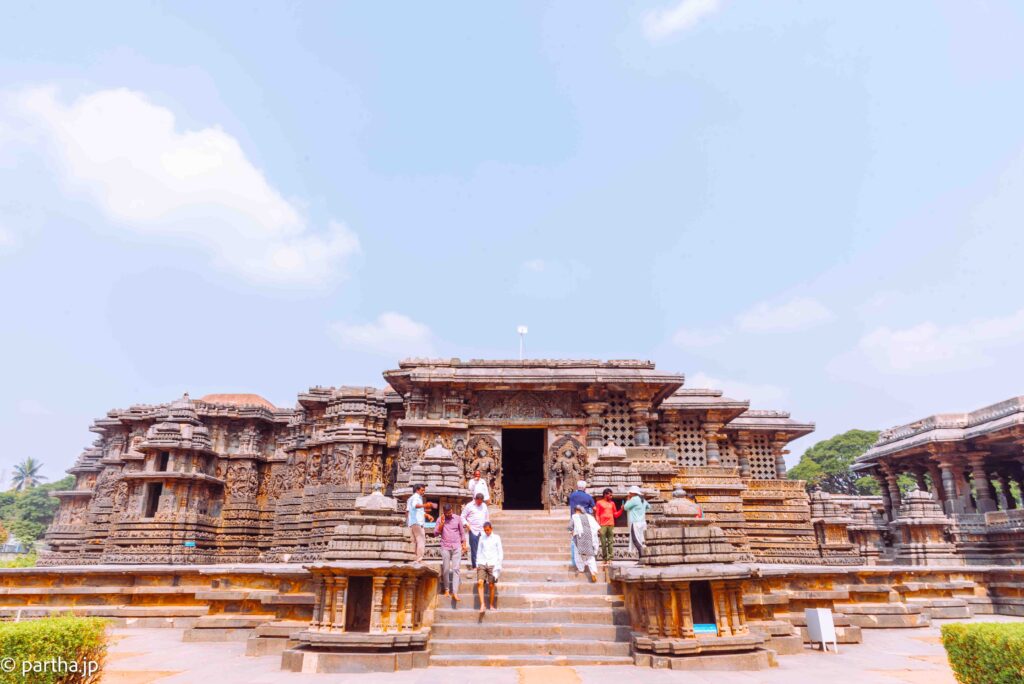
I have traveled to India almost every year in the two decades that I spent in Japan but there has been little time to do sightseeing. There are family visits, temple visits and shopping. Between maintaining familial, spiritual and material ties there is little time for anything else.
But this year, the one where we went back as foreign passport holders there was a desire to visit the past, explore the culture and maybe a faint attempt at holding on to something that was slipping away.
The temples were built by the Hoysala dynasty who ruled parts of Southern India between the 10th and the 14th centuries. The dynasty finally came to an end in the mid 14th century and came under the Vijaynagara empire who built the magnificent temple town of Hampi which is now a UNESCO Heritage site. Salman Rushdie, the famous British Indian author wrote a book ‘Victory City’ on the Vijaynagara empire.
We branched off from the highway in Hassan, following the signs towards Belur, passing a central government controlled security forces camp on the way, puzzled by the presence of the camp in the remote and rural location until we passed the satellite monitoring facility of the Indian Space Research Organisation.
The presence of this advanced facility, focused on space research in this remote hamlet was a surprise. The country has made rapid progress in space research, sending satellites to the South Pole of the moon, the fourth nation to do so. There have been missions to Mars, developing satellite launch vehicles allowing other countries to launch their own satellites.
There was the surprise at finding the monitoring station at this remote location, but there was also the symbolism. A few kilometres from the millet and paddy fields, the thatched roofed huts of the farmers with their small holdings, was one of the most advanced technology centres of the world.
We branched off from the highway in Hassan, following the signs towards Belur, passing a central government controlled security forces camp on the way, puzzled by the presence of the camp in the remote and rural location until we passed the satellite monitoring facility of the Indian Space Research Organisation.
The presence of this advanced facility, focused on space research in this remote hamlet was a surprise. The country has made rapid progress in space research, sending satellites to the South Pole of the moon, the fourth nation to do so. There have been missions to Mars, developing satellite launch vehicles allowing other countries to launch their own satellites.
There was the surprise at finding the monitoring station at this remote location, but there was also the symbolism. A few kilometres from the millet and paddy fields, the thatched roofed huts of the farmers with their small holdings, was one of the most advanced technology centres of the world.
They existed side-by-side and there was nothing incongruous in that dichotomy, the progress of a nation pulled different parts to different directions.
We passed this shrine to the future to reach one from the past.
Vendors and hawkers surrounded us the moment we alighted near the parking area of the temple, selling us guide books, brass idols and post cards.
I bought the guide book, it was rare to find one on sale these days, cellphones with internet access killing off anything written on paper.
’The construction of the temple commenced in 116 AD at the instance of King Vishnuvardhana, his son and later on his grandson completed it. According to historical records, it took about 103 years to complete this profusely sculpted masterpiece of Hoysala architecture’, the guide book says. The Adverb seems to have displaced the adjectives in this description!
The guidebook is published locally was coated in brevity except for a few adjectives scattered around. In a world where Wikipedia or AI collates information, this book with pictures and maps was surprising.
The guide book, despite an abundance of adjectives and an occasional adverb contains detailed descriptions of the sculptures, the meanings behind them, the references to events in the folklore and by the time he was finished, I was wiser but exhausted.
A guide approached us when we enter the temple complex, we refused initially, he was not persistent and remained helpful, pointing out where we should leave our footwear and other helpful tidbits.
We are impressed with the attitude and after a brief discussion decide to hire him. He asks us our preferred language, he spoke English and the local language, Kannada.
I speak Kannada, it’s the language my family speaks , my forefathers came from a region where it was spoken. However I grew up in a different part of the country where a different language is spoken and my Kannada skills are limited to simple expressions with words from other languages thrown in.
As our guide launched his descriptions of the sculptures in flowery Kannada, I realised the limits of my comprehension. There were descriptions which were beyond my understanding, some of them had to be repeated in English and there were a few which passed me by.
The friezes were from mythology, embedding stories from the past on to rock. There were images that were comprehensible through the guide’s explanations, ancient mythology has a lot of stories.
There was a portion of the sculptures devoted to the erotic, figurines indulging in sexual acts, something that might seem strange in the modern age with it’s ambiguous morality, but it must have seemed normal almost a thousands years ago and the figurines still stand!
There is little background on why depictions of these acts were added to temples, one theory is that they were representations of Eternal Bliss, another more optimistic one talks about a free and liberal society almost a thousand years ago, but these friezes are not particular to this temple they are present in many others across different parts of India, notably the Khajuraho ones.
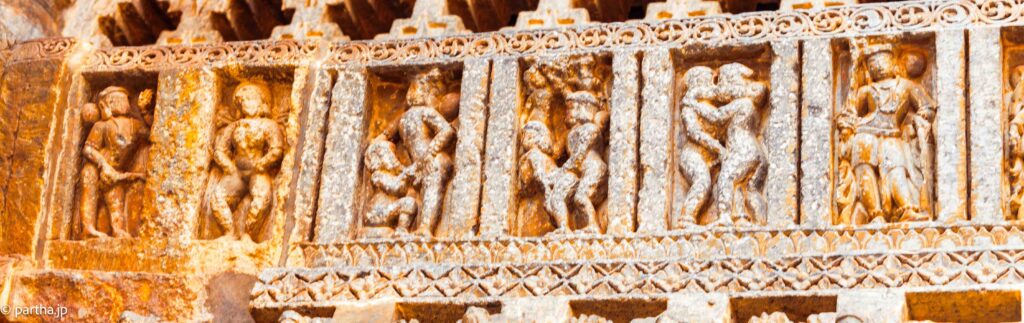
’Today, this small town basking in the warmth of it’s luxurious greenery and glorious past is regarded as ‘one of the jewels’ of South Indian architecture… the guide book says.
There is greenery around the Halebeedu temple, the river flows close to it, there is a park with trees planted in it. The temples are well preserved and maintained, they are chemically washed and waxed once in every decade.
The guides regulate discipline pointing out where shoes should be kept before entering the temple and generally maintaining order.
There were tourists from overseas at the site, there was a Muslim school tour group from Kerala, and there were locals. The overseas tourists were mostly in groups though there were a few individual stragglers including a lady wearing an Indian dress.
The morning Sun was warming up as we left the site, stopping to buy a brass idol collection, having promised the vendor on our way in.
‘Please don’t bargain, these are made by local artisans’, he said.
The atmosphere was calm, there were no aggressive touts or vendors and we made our way to the second town, Belur.
We passed dusty streets, city markets with shops all around and were dropped in front of the temple by our driver.
‘I will find a a parking spot, please call me when you are done and I will come over to the same spot’, he said.
‘Beautiful Belur, the quaint little town set elegantly on the banks of the river Yagachi amidst lush surroundings was earlier known as Velapuri……’ the first lines of the tourist guide book we bought from the vendor.
The morning Sun was warming up as we left the site, stopping to buy a brass idol collection, having promised the vendor on our way in.
‘Please don’t bargain, these are made by local artisans’, he said.
The atmosphere was calm, there were no aggressive touts or vendors and we made our way to the second town, Belur.
We passed dusty streets, city markets with shops all around and were dropped in front of the temple by our driver.
‘I will find a a parking spot, please call me when you are done and I will come over to the same spot’, he said.
‘Beautiful Belur, the quaint little town set elegantly on the banks of the river Yagachi amidst lush surroundings was earlier known as Velapuri……’ the first lines of the tourist guide book we bought from the vendor.
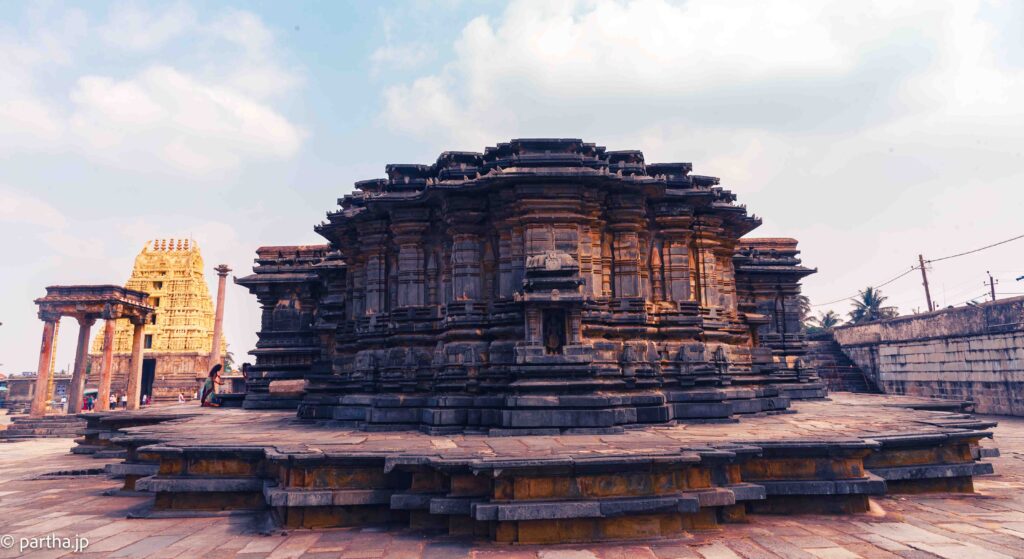
This is a large and spacious complex, stone slabs forming the flooring , there is a main sanctum, vestibules and a pillared hall(Mandapa) for rituals.
Tourists were in abundance here, there were groups of people who spent a long time taking pictures of each other, men posing in sunglasses and the women , a few ordained in beautiful Sarees, others in more modern attire, taking selfies and videos on phones mounted on stands.
Some of them were obviously influencers creating reels for their posts, striking poses to attract views. This was a 11th century temple and a profession that was created in the 21st century seemed to be flourishing here!
We had to wait at some places for the previous occupants to vacate before taking pictures, the influencers wanted their perfect pictures and the ones who weren’t ‘influencing’ took selfies in different poses adjusting their sunglasses for their shots, they just wanted to impress their friends on social media!
However the crowds were orderly, the temple complex well maintained and the only discomfort came from the rising mid-day heat.
The vendors outside the temple sold items similar to the ones at the earlier temple, the guide books, brass idols and other knick knacks. They also had similar sales pitches the items were made by ‘local artisans’.
It was around 13:00 by the time we left, the afternoon sun was warm and the vast spread of the temple complex exhausting after a while. We looked for places to have lunch but the town was small and not enough options available.
Belur and Halebeedu are small towns, the tourists are mainly locals, I did not see too many tourists from other parts of India, the non-Indian ones were less than a dozen. The towns have not developed the infrastructure to support tourists, I could not find a single restaurant that I was comfortable eating in.
There are no organised tours from nearby cities like Bangalore and there probably is an opportunity here. Hampi, which is located in the same state but is around 500 kms away is where the tourists go , I visited that town around 25 years ago, going for a business meeting at a nearby steel plant and taking time in the afternoon to visit the ruins.
Hampi is better known as it was the last Hindu empire before the Muslim invasions, but Belur and Halebeedu, in my opinion deserves greater, if not equal, patronage.
The hawkers, the street vendors are not aggressive, the touts negligible, that might count as plus points, but they probably are not present in numbers because the business is limited.
However the tour guides earned my admiration, they enquired and did not persist after getting rejected.
We finally found a place to eat around 30 kms from Belur, as the roads climbed into to coffee plantations, there was a plantation cafe, clean and spacious and with enough options for us, craving local food, or even the locals who craved outside food. Besides the ‘meals’ there were pizzas, pastas and a wonderful selection of desserts.
We settled for the ‘meals’ climaxed by a coconut mousse. The quantity of rice that was served was large and both of us had rice left over by the time we finished.
The owner of the cafe walked over and offered to send in more curries to finish off the rice.
‘You should not waste food’, he chided us gently.
Though we agreed with him, we were not in a position to eat more. There was another five hours drive ahead of us and apologised and made our way out.
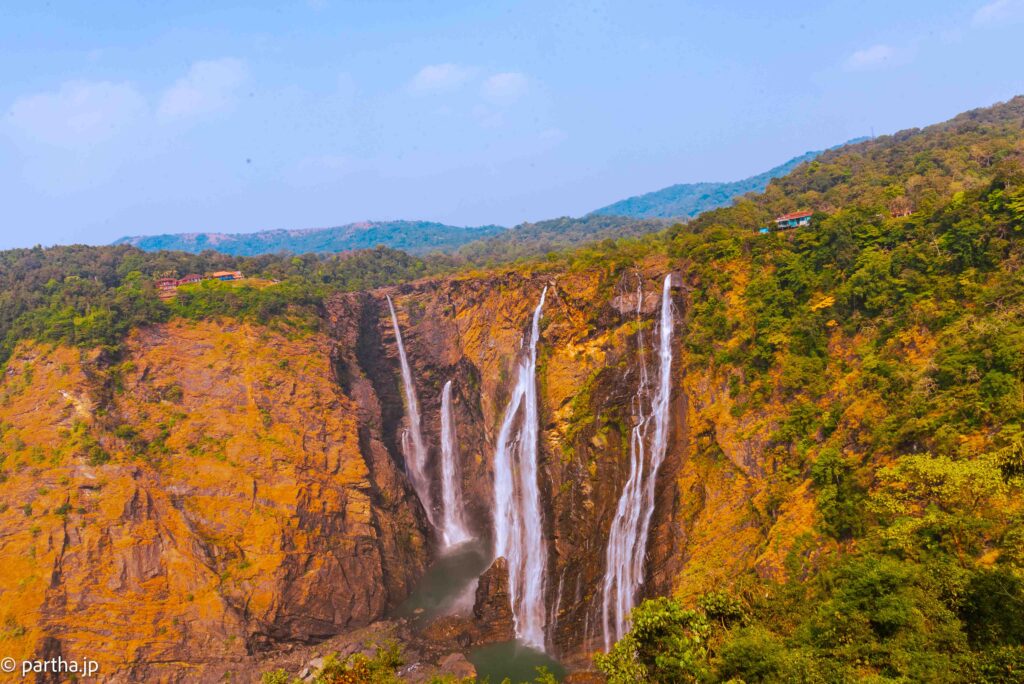
Over the next few weeks we visited temples, waterfalls and spent time with the family. This was a family trip after two years, there was a lot to catch-up on a lot more to see and experience and somewhere a nagging feeling that these visits would reduce in frequency.
We settled for the ‘meals’ climaxed by a coconut mousse. The quantity of rice that was served was large and both of us had rice left over by the time we finished.
The owner of the cafe walked over and offered to send in more curries to finish off the rice.
‘You should not waste food’, he chided us gently.
Though we agreed with him, we were not in a position to eat more. There was another five hours drive ahead of us and apologised and made our way out.
Over the next few weeks we visited temples, waterfalls and spent time with the family. This was a family trip after two years, there was a lot to catch-up on a lot more to see and experience and somewhere a nagging feeling that these visits would reduce in frequency.
A few days later I made my way back to Bangalore in a night bus, it was advertised as a ‘sleeper bus’, the train and flight options not convenient and a car ride not worth it.
The bus went at break neck speed and I was tossed around in my ‘Sleeper’ seat. There were two toilet stops, most buses still don’t have toilets on the inside, the passengers rushing out at each stop.
Six hours of getting tossed around the bus and I was in Bangalore! The bus journey had not changed over the years, the buses were shinier and more comfortable, but the convenience of toilet stops on the way, at places with clean toilets was still not available.
Train services have not picked up, they are neither frequent not easily reachable, the train station located on the outskirts of the city. Air fares sky-rocket during peak periods, there are days when you can fly 3,000 kilometres at the same cost as that of flying the 400 kilometres in the plane.
The roads however have improved, driving down is an option, there are parts of the highway that are still under construction and once that portion is completed the driving time will become shorter.
The infrastructure improves in bits and pieces, there are no giant steps, but the accompanying discipline, the one that is required to improve overall standards still lag behind.
Buses are comfortable, the roads are better but taking advantage of both these factors to improve customer experience, provide more comfort it lagging.
There are days when you despair and there are days when you are filled with hope. You cannot help feel that days of despair are becoming lesser and hope has a wider space.
A few days into my trip I ended up at a restaurant with a group of people, relatives in friends. The restaurant was located a place that defined the borders of Bangalore two decades ago. There were a few developments in those days but there was a large part which was still empty land and the distance from the city centre held back more construction.
But today it teemed with houses, apartment complexes and restaurants that took advantage of the availability of land. Our restaurant had a long path leading to the main seating area, there were annexes around the main area allowing a capacity of a few hundred people.
There was a DJ station in the middle and it played music from a list, a live DJ had been promised and he arrived on time!
The next hour revealed a side to the city, the country that I had not seen before.The DJ started with a few western pop songs, warming up the crowds, our inebriation matched by the beats, controlled yet progressively louder!
He played regional songs, switching between Hindi, Telugu, Tamil, Malyalam and finally the local language Kannada. One of the songs that I remembered from an Instagram Reel was more than ten years old, a bit obscure outside the state where it was released and the language it was in.
It became popular a decade later because a dance choreographer in Mumbai created a dance performance using the song as a background, a young girl danced with robust, energetic movements, her eyes dancing louder the smile even louder while the choreographer in the background shadowed her with the movements even louder.
The DJ started the song in the middle, the singer at a high note and the crowds in the restaurant reacted, a few copying the dance that revived the popularity of the song.
‘My dear, take me with you to see the Thrissur(a city in Kerala state) fair’
The ‘My dear’ in the language reached a high note and the crowds went wild.
I have two left feet, my dancing lacks any form of rhythm and copious amounts of alcohol are required for me to lose my inhibition and shake my body in unexplainable contortions.
And there in that restaurant, the loud music in the background, the dancers in the foreground, music in multiple languages, people dancing close to their tables, a few venturing out to the DJ Platform, in that order amongst the seeming chaos, was a vision of the country that I hoped for but never saw.
The noise, the endless din, the continuous mayhem in the chaotic streets, the cities either decaying or crumbling in their march forward was what bound everything together.
There was the chaos and there was the order embedded, not visible but omnipresent. The march to progress was not smooth, the road was full of potholes, you just needed the intuition to recognise them and jump over them.
I walked back the long path to the main road to catch my Uber, the car arriving in minutes. A few days later, a cousin ordered groceries from an app that guaranteed delivery within ten minutes, food delivery apps deliver all types of food to all corners of the city, I saw a delivery agent out at 2 AM in the morning.
There were more than 300 channels on cable TV, the mornings started with religion and astrology, God-men and Shamans or sometimes both.
The spiritual appetites whetted, the material ones were fulfilled by the stock market advisors, the afternoons were for the Soap Operas, often endless, the characters would head for lunch and even if you missed out the episodes for a few weeks, they would still be at lunch. The evenings were for sports and entertainment before the Soap Operas returned again late at night.
The spiritual, the material and the fantastic were all there. Everything was up for order, happiness was just a click away!
There was a vision of paradise here, chaos outside but a private heaven on the inside of the homes. Each one owned a private paradise.
I prepared to leave this paradise as the day of departure arrived and I headed to the airport, the building was another modern marvel. Terminal 2 of the Bengaluru airport is described as ‘terminal in a garden’, it is built around theme of ‘Garden City’ as Bengaluru(formerly known as Bangalore) is known as. The building uses bamboo in its ceilings and has around 3,600 plant species.
I went to check in at the Cathay Counter, and both my baggages were overweight.
‘Sir, can you shift some of the weight to the other bag’, the lady at the check-in counter asked me, almost apologetically.
I smiled at her and before I could reply her supervisor asked me to hold on for a minute, called up , I am guessing, his supervisor and told me
‘Sir, we will allow the excess weight this time, please be careful from next time onwards’.
There was another passenger on the adjoining counter, who also had been told that he baggage was beyond the permissible weight limits.
‘Do you know who you are talking to’, I am a One World Sapphire member’, he thundered.
‘You are just a staff, you don’t know anything, call your manager’, he continued.
I had no desire to listen to the rantings of this entitled buffoon and made my way to immigration and the lounge afterwards.
I have no doubt the man got away and was allowed the excess baggage, international airlines avoid causing scenes and Cathay Pacific probably allowed the buffoon to get away with insulting their staff.
Shiny building, polite airline staff, efficient immigration and baggage screening is what the government can manage, what it cannot manage is entitled idiots who break rules and demean those they perceive to be inferior to them.
You can create rules but if there is no deterrence from breaking these rules, they will continue to be broken. You can put up signs for not throwing trash on the streets, but there will be people who will throw that trash on that sign.
Thoughts of that behaviour still agitated my mind as I made my way to the lounge, named 080 after the Bengaluru city telephone code. The lounge was crowded, the seats occupied. I found a table meant for four, with a single occupant who was busy talking on his phone.
The lounge manager came to greet the other occupant, a few of the staff came over to ask what he needed, he seemed like someone important. He looked at me from the corner of his eye, the unwelcome intruder, as I took my place at the table.
The entitled idiot at the airline counter was still in my mind as I settled myself comfortably at the table. It was meant to seat four and there was no excuse for a single person to occupy it at that crowded hour.
I went over to the buffet area and filled my plate and came back, giving the other occupant a brief look. He did not look at me directly, but continued sneaking looks slyly while talking on his phone. There was no confrontation, no one asked me to move and I, happy at avoiding a conflict, continued with my feast!
I landed in Hong Kong the next morning, showered and relaxed in the lounge and boarded my flight for Tokyo landing a few hours later.
After landing, I de-boarded and walked to the immigration gates, the plane parked closer to the terminal entrance so it was a short walk. The immigration line separates the visitors and the residents, visa holders are also classified as residents.
As I took a right the staff guiding the travellers looked at me and asked ‘Re-entry? ’, meaning if I was on a resident visa. I took out my red passport and showed it to her.
Most times when I come back to Japan the line for Japanese passport holders is always short, the ones for visitors long, but at this hour there were more Japanese passport holders than visitors.
I joined the line and got a few looks, people assumed I had entered the lane wrongly, I took out my passport, placing it on top of the cover, deterring anyone who would try to tell me I am in the wrong lane.
There were around thirty to forty people in the line and I am the only one who looked different, the immigration officer watched the monitor closely when I placed my passport on the machine reader.
I went down the escalator and completed the customs procedures, interacting with machines to scan my passport and the QR code, exiting and making my way to the bus ticket counter.
I was in the bus a few minutes later, relaxing in the warmth of the heating after standing out in the cold for a few minutes. I stretched back on my seat, content, there was also the warmth from the feeling of being back in the familiar.
I look different, I talk different, I behave different but despite sticking out, I know that this is where I feel at home!